



Find the weaknesses before attackers do.
HWG Sababa tests security from the attacker's perspective – identifying weaknesses, validating what can actually be exploited and revealing the attack paths that could lead to critical systems, data and operations.
Our in-house specialists work across infrastructure, applications, cloud, identity, OT, products and AI – from vulnerability assessment and penetration testing to objective-based Red Teaming and specialized security testing.
You can't strengthen what you haven't tested.
Modern attack surfaces extend far beyond networks and applications. Identities, cloud environments, APIs, industrial systems, connected products and AI create new entry points and new ways for weaknesses to be combined.
A scanner can identify potential vulnerabilities. It cannot always show whether an attacker can exploit them, chain apparently minor weaknesses together, bypass existing controls or progress toward a critical asset.
Offensive Security provides that evidence – testing what holds, what fails and what an attacker could actually achieve under realistic conditions.
Offensive across every domain we defend.
Infrastructure
Assess internal and external infrastructure, networks, wireless environments, configurations and hardening to identify exploitable weaknesses and attack paths.
Applications
Test web, mobile and APIs through penetration testing, source code review, SAST and DAST – extending security into development and production environments.
Adversary simulation
Run objective-based Red Team exercises, from assumed-breach to full-scope scenarios, to test whether an attacker can reach a defined business objective and how existing defences respond.
Specialized testing
Extend offensive testing beyond the traditional IT perimeter – across cloud and identity attack paths, OT/ICS, components and firmware, and AI applications and LLMs.
From exposure to proven risk.
HWG Sababa progressively moves from identifying potential exposure to demonstrating what an attacker could actually achieve.
Testing can validate findings, safely reproduce attack techniques and, where relevant, explore privilege escalation, lateral movement and paths toward critical assets. Scenarios can be threat-led, objective-based and repeatable, with retesting used to verify that remediation holds.
The results should not end in a report. Offensive findings provide technical evidence for remediation and can also highlight where detection and response need to improve.
Within HyperSOC®, this creates a feedback loop between attack and defence – using what offensive specialists prove to strengthen detections, response logic and security operations over time.
Turn attack evidence into stronger defence.
Focus on real risk
Separate theoretical vulnerabilities from weaknesses and attack paths that create demonstrable risk.
Prioritize what to fix first
Direct remediation toward exposures with the greatest potential impact.
Validate security under realistic conditions
Understand how systems, controls and teams perform against realistic attacker techniques.
Strengthen detection and response
Use offensive findings to identify defensive gaps and improve security operations.
Verify that improvements hold
Retest after remediation to confirm that weaknesses have been effectively addressed.
Explore Offensive Security in practice.
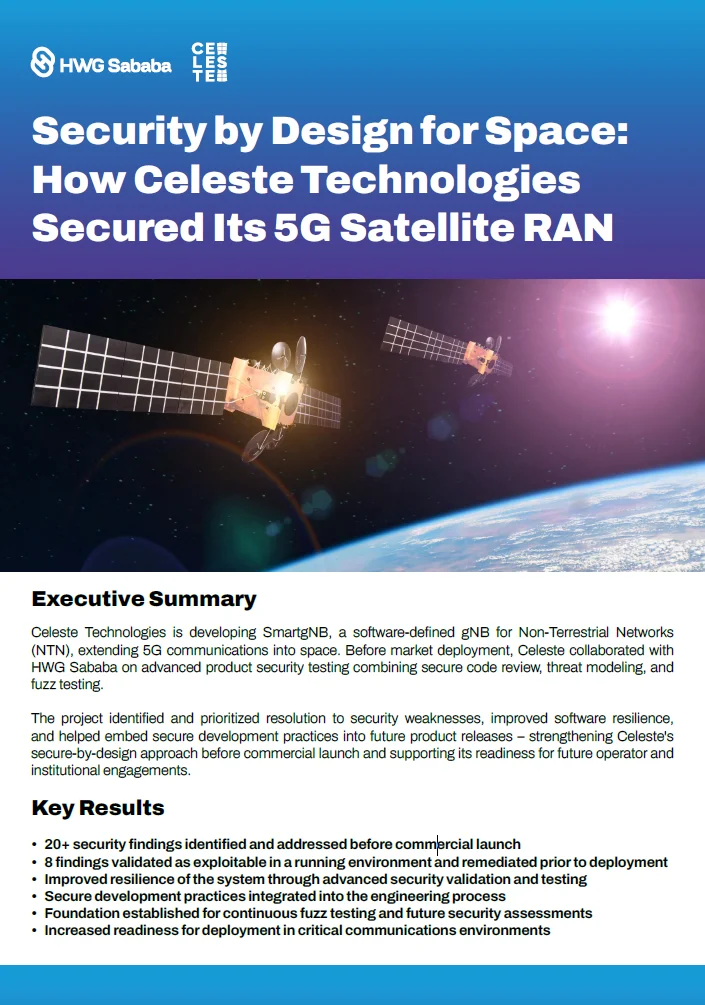
Celeste Technologies: Security-by-Design for Satellite 5G
Celeste Technologies is developing SmartgNB, a software defined gNB for Non-Terrestrial Networks (NTN), extending 5G communications into space. Before market deployment, Celeste collaborated with HWG…

Penetration Testing for MIX
As Italy's leading Internet Exchange Point (IXP), MIX, faced unprecedented challenges during a period of explosive traffic growth and heightened cyber threats. Ensuring operational continuity…
Penetration Testing for Arduino
As part of the go-to-market process for Opta, micro-PLC with IoT functionalities, Arduino, leading open-source hardware and software company, committed to actively verify its security…