


There is no single truth when we focus on cybersecurity. Security decisions, perspectives and priorities change depending on roles, context and the nature of the risk.
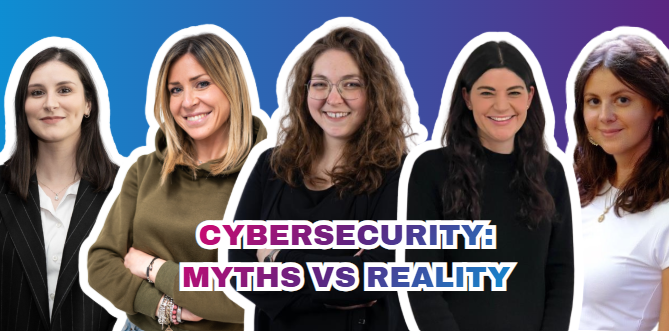
This article takes shape through the exchange of insights among HWG Sababa’s cybersecurity professionals who operate in different fields – from strategy and threat intelligence to industrial cybersecurity and ESG – and bring complementary viewpoints on security. What emerges is a collective perspective that brings together diverse viewpoints to challenge persistent myths and clarify which security decisions can no longer be delayed, going far beyond the traditional CISO perimeter.
For the fifth year in a row, cyber incidents rank as the top global business risk, according to the latest Allianz Risk Barometer. They sit at the center of a crowded risk landscape, alongside the rapid rise of artificial intelligence, growing business interruption, climate-related events, and increasing regulatory pressure. In this context, the security decisions organizations make – or delay – have never been more consequential.
This positioning matters. Cyber risk is deeply interconnected with many of the other threats companies face today. And yet, despite being widely acknowledged, cybersecurity is still too often misunderstood when it comes to prioritization and decision-making.
Many organizations continue to treat cyber incidents as a purely technological issue, or as a responsibility confined to IT teams. In reality, cyber risk is systemic. It affects operations, supply chains, compliance, reputation, and ultimately business continuity. When security decisions are addressed in isolation, cybersecurity remains a weak point. When approached holistically, it can significantly reduce exposure to a wide range of other risks.
From tools to complexity
Buying tools, adding controls, or reacting to incidents after they occur is no longer sufficient in an environment where attacks are continuous, targeted, and increasingly automated. These reactive approaches often lead to fragmented security decisions, disconnected from broader business strategy.
Cybersecurity today requires a more complex approach: governance instead of silos, coordination instead of fragmentation, and preparedness instead of reaction. This shift is about putting technology in service of strategy, processes, and people – and about making informed security decisions that reflect how organizations actually operate.
To better understand what is holding organizations back – and which security decisions can no longer be postponed – we looked at cybersecurity through the perspectives of HWG Sababa experts who work daily with businesses across different industries, sizes, and maturity levels. Across disciplines, the same pattern emerges: the biggest challenges are not a lack of solutions, but delayed decisions, underestimated priorities, and persistent myths that slow down action.
The priorities shaping cybersecurity in 2026
One of the most visible shifts shaping security decisions in 2026 is the role of artificial intelligence. AI is becoming essential to handle the speed, scale, and volume of modern attacks. Automation enables faster detection, response, and prioritization – not to replace human expertise, but to make it effective under pressure.
As Valeria Maurogiovanni, Project Manager, explains: “In 2026, a CISO can no longer postpone the decision to implement a cybersecurity strategy based on artificial intelligence. As threats evolve, AI becomes essential to detect and respond to incidents in real time, automate security operations, and strengthen the overall security posture.”
At the same time, Cyber Threat Intelligence is evolving. It can no longer remain descriptive or detached from business decisions. As Alessia Fincato, Cyber Threat Intelligence specialist, highlights: “Cyber Threat Intelligence must become a real decision-making tool, integrated into risk management, business strategy, and investment planning – including those shaped by geopolitical dynamics rather than purely financial motives.”
Operational Technology represents another critical frontier influencing security decisions. The separation between IT and OT is increasingly artificial, while the consequences of incidents in industrial environments are very real. “OT security requires unified governance, asset visibility, network segmentation, and incident response designed specifically for industrial environments.”, notes Irene Parodi, Industrial Cybersecurity Specialist.
Finally, supply chains further amplify complexity. “An organization may be well protected internally, yet remain vulnerable through partners, suppliers, or third parties with lower cybersecurity maturity.” – observes Maria Stella, ESG Lead.
In this context, cyber risk extends well beyond organizational boundaries and becomes a shared ecosystem challenge – one that demands coordinated security decisions across the value chain.
The real decision
Despite these realities, several myths continue to slow progress: that cybersecurity is “only an IT issue,” that OT security can be addressed separately, or that responsibility ends at the perimeter of the organization. As Dalila Barone, Security Manager Specialist, explains: “One of the most persistent myths is believing that adopting the right technologies is enough. What really makes the difference is how those technologies are managed, monitored, and integrated into daily operations.”
These assumptions fragment accountability and delay the very security decisions that could strengthen resilience.
In 2026, the most critical security decision for CISOs and security leaders is not selecting a specific technology or framework. It is deciding to treat cybersecurity as a continuous, shared, and strategic discipline – embedded across governance, operations, decision-making and corporate culture.
Cyber risk may top global rankings, but how organizations act on their security decisions will determine whether it remains a vulnerability or becomes a source of resilience in an increasingly complex world.